
Thanks for Submitting To Watch the Permit Backlog Webinar
Watch the on-demand recording below. Hit play to get started!
Put What You Learned Into Action
You’ve got practical insight — now make it count. Connect with our team to explore solutions that keep projects on schedule and help your community meet housing demand.
Featuring:
Joe DeRosa, President at SAFEbuilt
With over 20 years in FinTech, SaaS, and business services, Joe is known for leading high-growth transformations. In addition, he’s the author of The Customer Mindset and serves on multiple software company boards, guiding growth, exits, and mergers.
Through his work at SAFEbuilt, he's worked with thousands of community leaders and understands the unique pressures municipalities face when balancing growth, budgets, and community needs.
He’s passionate about helping local governments find innovative, sustainable solutions that strengthen communities and support long-term development.
Speaker 1: [00:00:04] Welcome, thanks for tuning in to this on-demand conversation with Joe DeRosa, president of SafeBuilt. Just a little bit of background on Joe. He's got about 20 years of executive experience, leading growth and transformation across SaaS, FinTech, professional services. At SafeBuild, he's helping modernize how local governments deliver essential services like permitting and inspections. In this session, Joe is gonna break down what's really behind today's permitting delays. From staffing gaps to outdated systems and what smart communities are doing to move projects forward faster. So let's dive in. Joe, why don't you start us off? What are you seeing right now regarding delays in the permitting process? Are things getting better or worse, just more complicated? [00:00:48][43.6]
Speaker 2: [00:00:50] So thanks, Jessica. So from where I sit, the permitting landscape itself isn't necessarily getting worse, but it is getting more complex. And if you take the permiting workforce in general, these are the folks that handle everything from taking in a permit application to reviewing the plans to code, to actually doing the inspections once the work starts. When you take that block or group of individuals, the average age. In that category is 55 to 64 years old, according to the Bureau of Labor Statistics. That puts us smack dab in the middle of what we call a silver tsunami. So you've got a chunk of the workforce that is actually gonna be exiting the workforce. And in fact, just a couple of weeks ago, the ICMA, which is the International City Managers Association just posted an article and 46% of city managers across the US are indicating that their biggest wave of retirements is coming in the next three years. So that's a lot of institutional knowledge. It's also a lot of permitting specific knowledge that's going out the door. So when you put all that together and you've got fewer people coming into this workforce and the trades, it creates these added pressures. And then you've got other things that come into play around the permitting process and timelines and delays that I know we'll talk more about. But one of them is around technology because the adoption of technology is uneven at best. And going from manual to digital workflows, those are all things that comes into play. So that's kind of what I'm seeing at eye level. [00:02:38][108.7]
Speaker 1: [00:02:39] What would you say like Safe Build's role is in all of that? Like how is Safe Build stepping in to help support and fill that gap? [00:02:46][7.6]
Speaker 2: [00:02:47] Yeah, and that's exactly the role. So we're there to reinforce, not replace. So we step in to provide the people support, to provide, the process, best practices, if you will and then anchor it all together or tie it all with technology. So our proprietary technology platform, Community Core, really brings all of these components together, people, process. And it provides all of your constituents with that line of sight on what's going on with their projects. [00:03:19][32.2]
Speaker 1: [00:03:20] You talked a lot about just the age, kind of like the age of the workforce and how that poses a challenge to a lot of institutions. And then you started to touch a little bit on technology. Can you dive in a little deeper there on the technology gaps that you're seeing and just like some more of those common bottlenecks that you are seeing during the permitting process? [00:03:44][23.6]
Speaker 2: [00:03:47] There's three primary bottlenecks that we see. One is the staffing piece, which we just talked a bit about. The second is also process. And part of what I mean by process is you take a municipality that has been operating off of the same process steps for 20 years. And the volume of work from 20 years ago isn't what the volume work is today. So you've now overlaid a higher volume of work on top of a process that was never built to sustain that level of work. So that creates efficiencies in bottlenecks and backlogs. And then to your point around technology, most of the municipalities in the US are still operating in a very manual, paper-driven environment. You're still going into many municipalities with your paper set of plans, a paper application, you're standing in line. And that technology really helps take the traditional, I'm gonna go stand in line to putting it online and in the cloud. And that we find decreases our turnaround timelines by 30% in communities that we serve. And it just removes the friction points. [00:05:05][77.7]
Speaker 1: [00:05:05] Something that you said just now about kind of like that, how things have almost aged over time as far as processes, what was built 20 years ago is not supporting the volume today. I wanna dive into that a little bit more and talk about that scale because there's obviously a cost associated with that. Like the impact of that delay in processes or the chain or the lag in kind of moving and updating processes to meet the demand. What would you say is the real impact of those delays, the delay in kind of updating their technology, processes for cities and developers? [00:05:43][37.9]
Speaker 2: [00:05:44] The developers have a set of impacts and then the cities or municipalities have a sets of impacts. So if I start with a developer, let's just use an example. Developers working on a 200 unit apartment complex and there's a 30 day delay. Within that delay, that developer has carrying costs, finance charges, these costs can reach three to $5,000 a day. In no time, you could be looking at. A couple hundred thousand dollars in additional costs just from there. And then you think about the average rent on a unit across the US is $1,800 a month. Now it's gonna be far more than $1 800 in Manhattan or Miami or LA, but nationally the average is $1800. So a 200 unit apartment complex that's delayed for 30 days, you're looking at $360,000. So that's from the developer's standpoint. But then you move to the municipality standpoint and you've got a delay in tax revenues collected because of course you can't start seeing tax revenue until you start having residents or businesses occupying the structure that was intended to be occupied. So that becomes a problematic from a revenue perspective. Then when you have fewer residents that are living there in that unit. Then you have less being spent on restaurants in local restaurants. You have less been spent with local businesses. So there's an economic impact that carries over just the 200 unit apartment complex. And I think one of the biggest impacts that gets hit is credibility. Because once you start with delays and once you miss timelines, everybody involved in the entire process takes a credibility hit and nobody wants that. So everybody wants to avoid it. And the point is that permitting is so much more than just about the paperwork and a process. It's really the economic infrastructure that underpins a community. Because if your community development is not moving, nothing else can. [00:08:02][137.2]
Speaker 1: [00:08:03] I think you highlighted such an important thing about people think of it as just as a piece of paper. But the kind of spider web effect that it has on every 30 days that it takes to get it approved. I mean, it costs hundreds of thousands of dollars or on both sides. So I think that's like, I wanna let that sink in for the audience of just like the cost of that is not just time and it's not just money for the developers or for. The city, but it is for the community. And that's, I think a lot of people can resonate with that because it's again, it's more than a piece of paper. So I think that's really important to highlight. People are just assuming. And I think like to your point about credibility, people are assuming that these delays are inevitable. But there's definitely ways that cities and builders can work to make the permitting process more efficient. What would you say, what are some of those ways that come to mind for you? [00:08:58][55.9]
Speaker 2: [00:08:59] I think the assumption of it is what it is, is the biggest mindset hurdle that we overcome on a day-to-day basis. We all have experience and tendencies to take a process that we dislike and say, it is it is or that's just how it is. But in this situation, it doesn't have to be that way. So there are options, there are alternatives. Communities can do a few things to really kind of tamp down the bottlenecks, so to speak. Early collaboration is critical. So the community meeting with the developer or homer having very clear expectations of this has to get done, this form, these are the steps. We develop checklists for a lot of our community partners which we find to be very effective because it's right there in front of you and it's a step-by-step guide. It removes the guesswork, right? So early collaboration is critical. Regular communications also critical and that is aided by technology. So with our platform on community core, when everyone has line of sight into where their project is, where their plan review is sitting, what's next? When that next inspection is gonna happen and when is it scheduled for? When everyone has that visibility, it removes friction because the expectations are clear. Where you have friction is when I don't know what's happening and I can't seem to get ahold of anybody because the process is so manual, right? So having that collaboration early on, having the communication, working with a partner that has a flexible capacity model helps. Kind of smooth out the peaks and valleys that you see in workloads across municipalities. [00:10:57][117.4]
Speaker 1: [00:10:59] Collaboration, flexible capacity models, having transparency into the data and where things are going. Let's talk about the communities who maybe don't have access to those resources or like they don't the staff or tech to streamline this. How do they approach that? How do the achieve the same kind of prevention of bottlenecks if they don't have access to those resource? [00:11:23][24.0]
Speaker 2: [00:11:24] Communities that kind of fall into that category just can really, it's more about keeping their head above water than it is rethinking a process, right? They're trying to keep up with the volumes that are there today and that becomes the biggest pain point. So many of our partner communities, we've started working with them really by providing part-time support or supplemental support to help clear a backlog or stabilize turnaround times. And what that does is it restores a level of confidence in the community that your community development process is working efficiently. And it also helps with two other big factors, work-life balance for the in-house staff and morale. So we've walked into several communities where you see overtime within their building department where people are working 20 to 30 hours a week of overtime. Not because they want to, but because the work volume is so high that they're just treading water and they're trying to get as much work done as they possibly can. Ultimately over time, that takes a hit on morale, right? So a big piece of this centers around that. The second piece is, even if you don't have a lot of resource, focusing on improving process is critical, right. So mapping out what your current process is then looking at the workflow that's coming in, looking for redundancies, looking for parts in the process where things have a tendency to break and fixing the process is actually more important before the technology piece. Cause you could take a great piece of technology, anchor it onto a faulty process and you've made no improvement, right. So the process piece is super critical. And being able to work with a partner that provides all of those things is much easier for municipality and that's what we provide. [00:13:27][122.9]
Speaker 1: [00:13:27] I love that you shared that. I think that's a really important piece to this. You mentioned a little bit about partnerships. Yep. Like where does SafeBuilt usually come in for these communities or developers? Like what can a third party provider actually do to help relieve the pressure on permitting teams? [00:13:46][19.1]
Speaker 2: [00:13:48] We start working with communities for a host of different reasons because every community is different. We may go into one community that recently had a retirement, right. So now there's an immediate staffing issue. There may be a community that has lost some key personnel for whatever reason. There's a staffing issue that has to be addressed immediately before a backlog starts or maybe the backlog has already started and it's already existed. Now this just exacerbates. The problem. So oftentimes we go into communities because of immediate staffing challenges. Sometimes we go in to a community to work with a city manager who's trying to optimize their budgets. City managers have a tough job balancing short and long-term budgets. They only have a limited amount of resources and they're trying to maximize every dollar that they possibly can. So sometimes we're in there. Working with communities to try to optimize the dollars that they have. Other times we get called in to help digitize the process. So again, to remove the friction points and be able to install something that's gonna be much more user-friendly, reduces complaints and just gives a better line of sight from the project. So at the end of the day, we're coming in to ensure that the community development continues to move forward in a quick. Safe, inefficient way. [00:15:15][87.6]
Speaker 1: [00:15:17] I was a city leader developer watching this and I'm already behind. Or if this is like what I've been continuously experiencing and I might already be overwhelmed. What's your advice to me? How would I avoid analysis paralysis? [00:15:31][14.1]
Speaker 2: [00:15:33] Start by having the conversation. So our team has a number of tangible examples, case studies. And in the benefit of working with a company like Safe, but we operate 2,000 communities across the country. So we have examples of communities that have a couple hundred residents in population all the way up to working with a city the size of Phoenix, the fifth largest city in the country, right? And everything in between. So I will be able to share with a city manager, a town administrator, a community development director, a problem that we have solved in a community that looks similar to theirs, right? Because if I'm in a township that has 7,000 people in it, I'm gonna be less interested in what you're doing for a city that has 2 million people in. So I wanna be able to see something that I'm gonna be able to relate to. So start with the conversation, look at the examples. And as they say, knowledge is power. And we love when we can actually help a municipality or a community really improve life. And life gets improved when things move smoother and there's less headaches and there is less friction points. So that's where I would say to start. [00:16:56][83.4]
Speaker 1: [00:16:58] Well, Jo, thank you so much for your time, for your insights. If you're looking to learn more about Safe Built, go to safebuilt.com, reach out. They're happy to start the conversation. And we look forward to seeing you all soon. All right, take care, everyone.
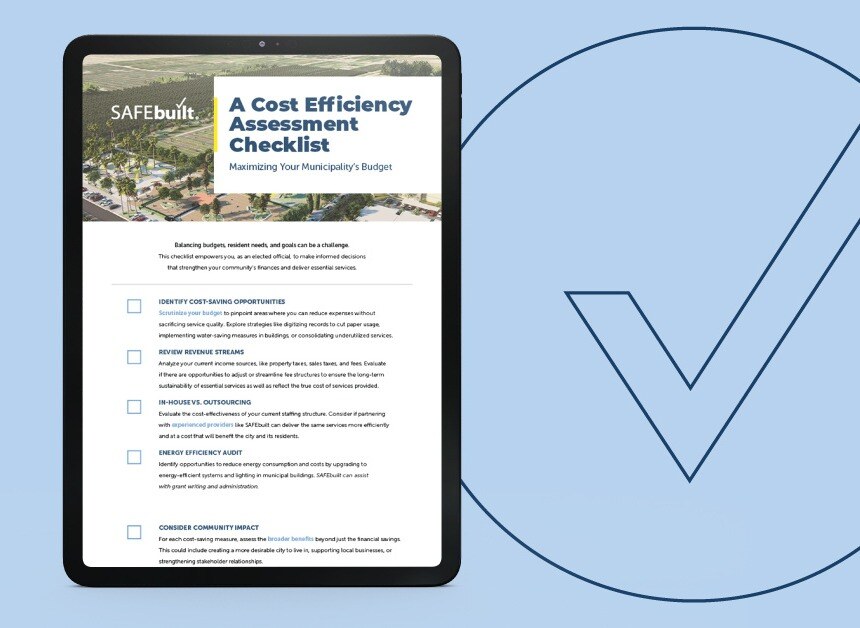
Cost Efficiency Checklist
- Prioritize pain points
- Leverage tools to maximize cost-savings
- Deliver real community impact
Looking for Support?
Find resources to help reduce delays, fill staffing gaps, and keep projects on track.

Talk to Our Team
Get answers to questions about inspections, permitting, or flexible support.

Improve Department Performance
Explore options to increase efficiency and keep projects on track.

Browse Resources
Read blogs, industry insights, and tools built for municipal leaders.